Benefits of Automation in Business - Drive Efficiency & Growth
#benefits-of-automation#business-automation#process-efficiency#automation-strategy#cost-reduction
October 12, 2025
When people talk about the benefits of business automation, three things usually come to mind: getting more done, saving money, and making fewer mistakes. But it's more than just swapping out a person for a piece of software. It's a strategic shift that builds a smarter, more resilient engine for your business, giving you a serious competitive edge.
The Real Impact of Automation in Modern Business
Let's get past the buzzwords. Automation isn't just about making a robot do a boring job anymore. It's about fundamentally changing how your company operates. Think of it less like a faster calculator and more like an entire data-driven advisory team - one that can strategize, predict, and adapt in real time.
This evolution is precisely why automation has become so crucial for any company looking to grow. It's the engine that powers smarter, faster, and more reliable operations. The core benefits we're about to dive into don't exist in a vacuum; they feed into each other, creating a powerful loop of continuous improvement.
This infographic lays out the domino effect that automation can trigger.
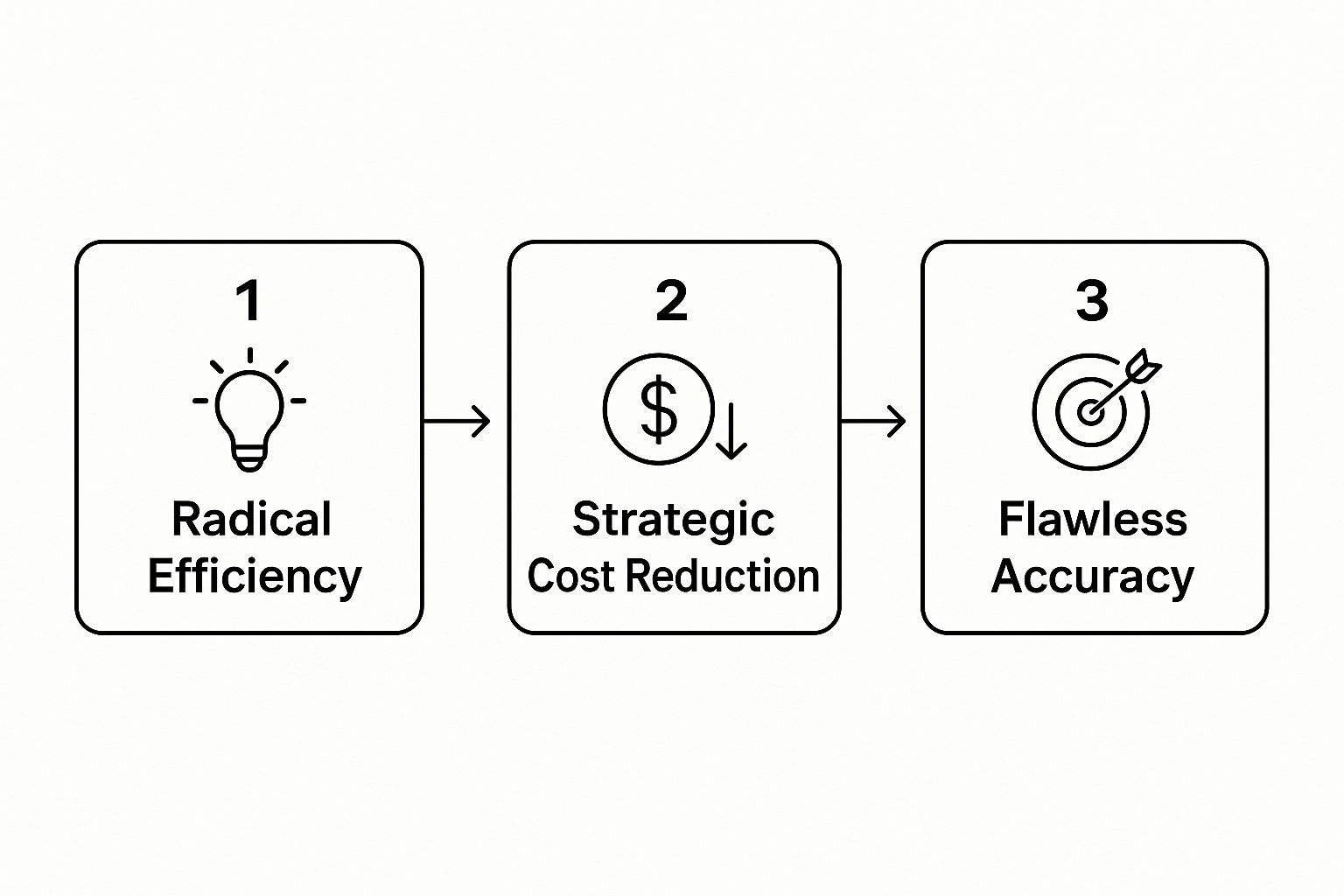
As you can see, it all starts with efficiency. That initial boost in speed and output directly fuels cost savings, which in turn frees up resources to focus on improving accuracy and quality across the board.
Understanding the Key Advantages
To really get a feel for how automation helps a business, it helps to see the benefits as interconnected pillars. Each one strengthens the others, leading to a massive cumulative impact on how work actually gets done.
"Automation is finally delivering on its promises. Context, adaptability, and real-time decision-making were always the hard parts, but now they're actually possible at a scale and speed we couldn't reach before."
The key advantages we'll explore throughout this guide are:
- Radical Efficiency: This is about more than just speed. We'll show you how automation can run complex, end-to-end processes 24/7 with almost no human intervention, creating a massive multiplier effect on your team's productivity.
- Strategic Cost Reduction: We'll dig into how automation lets you optimize costs intelligently. It's not just about payroll; it's about smarter resource allocation, leaner supply chains, and getting rid of the hidden costs of operational waste.
- Flawless Accuracy: Discover how automated systems follow rules perfectly every single time. This completely removes the risk of costly human errors in critical areas like data entry, invoicing, and compliance checks.
- Built-in Scalability: Learn how automation lays the groundwork for growth. It lets your business handle huge spikes in demand without the usual friction and hiring headaches that come with manual processes.
To make these concepts even clearer, here's a quick summary of how each benefit area translates into real-world business outcomes.
Key Automation Benefits at a Glance
| Benefit Area | Primary Impact | Business Outcome |
|---|---|---|
| Efficiency | Faster completion of tasks and workflows | Increased output, accelerated project timelines, and improved team capacity. |
| Cost Savings | Reduced manual labor and operational overhead | Higher profit margins, better resource allocation, and lower cost per transaction. |
| Accuracy | Elimination of human error in repetitive tasks | Improved data quality, enhanced compliance, and greater customer trust. |
| Scalability | Ability to handle increased workloads without proportional cost increases | Seamless growth, consistent service delivery, and readiness for market expansion. |
Each of these advantages represents a significant step forward for any organization. When combined, they create a business that isn't just surviving - it's built to thrive.
Achieving Exponential Efficiency Gains

Real operational speed isn't about making one person work faster. It's about getting your entire workflow to operate like a single, intelligent unit. This is where automation delivers its most dramatic punch. Think of it as the difference between a talented solo guitarist and a full rock band playing in perfect sync - the combined sound is infinitely more powerful.
That same principle applies directly to your business. The biggest wins from automation come from this interconnected approach. When you start linking previously separate systems and processes, you create a multiplier effect on productivity that completely eclipses the small gains you get from automating isolated tasks.
This strategy has a name: hyperautomation. It's a leap beyond just replacing a manual step here or there. Instead, it involves weaving together technologies like artificial intelligence (AI) and machine learning to manage complex, end-to-end business functions. This is how companies build systems that don't just work faster, but also learn and adapt over time, creating a powerful cycle of continuous improvement.
Orchestrating the Entire Customer Journey
Think about the path a customer takes when they engage with your company. It starts with a click on your website, moves through sales and fulfillment, and wraps up with delivery and support. When handled manually, this journey is full of handoffs between different teams and software, creating friction and delays at every turn.
Hyperautomation flips that script. The goal is to connect and automate that entire sequence into one fluid motion.
- Initial Inquiry: An AI-powered chatbot can greet a potential customer, answer their initial questions, and route them to the right sales channel without missing a beat.
- Order Processing: The moment a purchase is made, the system can automatically generate an invoice, update your inventory records, and send a fulfillment request straight to the warehouse.
- Delivery and Support: From there, the system tracks the package, pushes real-time shipping updates to the customer, and can even schedule a follow-up email to check on their satisfaction.
This deep integration is at the heart of modern business process automation. Companies are now automating entire customer journeys, which allows them to run 24/7 with minimal human intervention and drastically shorter cycle times. You can find more insights on AI's role in process automation on devcom.com.
By building a system that runs the entire customer lifecycle, you're not just speeding up individual steps. You're creating a self-sufficient operational engine that runs continuously, identifies bottlenecks on its own, and refines its performance, delivering a truly scalable advantage. This is how efficiency moves from being an incremental gain to an exponential one.
Unlocking Real-World Cost Reductions

Let's be honest, the biggest draw for automation has always been its promise to slash costs. But if you're only thinking about reducing payroll, you're missing the bigger picture. It's like seeing only the tip of an iceberg. The real financial wins come from optimizing costs across your entire operation, building a much leaner and more resilient company.
Modern automation isn't just about replacing simple tasks anymore. AI-powered systems can act as a financial co-pilot for your business, using predictive analytics to help you make smarter decisions about where to put your money. It's a shift from just reacting to expenses to actively managing your finances.
Think about it: an automated system can dig into your past sales data to accurately forecast demand. This means you stop overspending on raw materials or overstaffing during lulls, preventing waste and directly protecting your margins.
It's About More Than Just Labor Costs
The true power of automation is its knack for trimming operational fat in places you might not even be looking. It tackles both direct and indirect expenses by making your core processes fundamentally smarter.
This isn't just theory; it's already changing how companies handle their money. We're seeing next-gen automation systems optimize complex supply chains in real time, intelligently adjust a building's energy use, and allocate resources with surgical precision. The savings start adding up across the board.
The numbers back this up. A recent report found that nearly 50% of companies have cut costs in HR activities using generative AI. On top of that, over 45% reported savings in their service operations, and about 46% saw reductions in supply chain and inventory management. You can dig deeper into these findings on business process automation on bitcot.com.
By letting automation handle decisions based on live data, businesses can achieve a level of cost control that's just not possible with a team of people. It's about making thousands of tiny, optimized choices every single day that collectively lead to massive savings.
The Clear ROI of Automation Tools
Tools like Robotic Process Automation (RPA) deliver a return on investment that's incredibly easy to see and measure. Think of RPA bots as digital employees that can flawlessly execute repetitive, rules-based work, like processing invoices or handling data entry.
Let's take a look at a classic business process: accounts payable.
- The Old Way: An employee spends their day manually typing in invoice data, cross-checking it with purchase orders, and scheduling payments. It's slow, tedious, and a single typo can lead to costly errors or double payments.
- The Automated Way: An RPA bot instantly pulls data from an invoice, validates it against your records in the system, and flags anything unusual for a human to review. The whole thing takes seconds.
This switch immediately cuts the cost of every single transaction. More importantly, it frees up your finance team from mind-numbing data entry so they can focus on high-value strategic work. The takeaway is simple: automation doesn't just cut costs - it builds a lasting financial advantage by making your entire operation run with greater precision.
Slashing Errors and Boosting Accuracy
We all talk about how automation saves time and money, and it absolutely does. But there's another, equally powerful advantage that often gets overlooked: its incredible precision.
Let's be honest, people make mistakes. Even your most dedicated employee can have an off day. A misplaced decimal point, an extra zero on an invoice, a typo in a shipping address - these small slips can quickly snowball into massive headaches, costing you money, creating compliance risks, and eroding customer trust.
Imagine a single data entry mistake in a crucial compliance report. Suddenly, you're facing a regulatory audit. The damage isn't just the potential fine; it's the hundreds of hours your team will spend fixing the problem and the hit your company's reputation takes.
The Power of Perfect Execution
This is where automation really shines. Automated systems are built to follow a set of rules, and they follow those rules perfectly, every single time. They don't get tired, they don't get distracted, and they never have a bad day. If you can map out a process, an automation tool can execute it with 100% accuracy.
By removing human variability from the equation, automation sets a new standard for quality. It ensures that essential tasks like data transfers, financial calculations, and order processing are done right from the very beginning.
This isn't just about preventing mistakes. It's about building a foundation of clean, reliable data that makes every other part of your business - from strategic planning to customer service - stronger and more effective.
Freeing Your Team for Higher-Value Work
Boosting accuracy isn't about replacing people; it's about re-focusing their talents. When you hand over the tedious, error-prone tasks to automation, you unlock your team's most valuable skills: their creativity, critical thinking, and problem-solving abilities. Instead of double-checking spreadsheets, they can start analyzing the data to find real business insights.
Think about what this looks like in practice:
- In Finance: Your team can move beyond manual data entry and start analyzing financial trends to offer strategic guidance.
- In Operations: Employees can focus on actually improving the workflow instead of just getting stuck in the day-to-day execution.
- In Customer Service: Agents can dedicate their time to complex customer issues that require real empathy and judgment, while automation handles the simple account updates.
By letting machines do what they do best, you empower your people to focus on the work that truly drives growth. This shift in how you use your team's talent is one of the most significant, yet underrated, benefits of bringing automation into your business.
Building a Foundation for Scalable Growth

Sure, the immediate wins in efficiency and cost are great, but the real game-changer with automation is how it sets you up for future growth. I've seen it time and again: manual processes are the single biggest anchor holding a company back from scaling up. As your business gets bigger, those manual tasks don't just add up - they multiply, creating friction that grinds everything to a halt.
Think of it like this: running your operations manually is like trying to manage city traffic on a single-lane country road. It works just fine when there are only a few cars. But the moment you hit rush hour, you've got gridlock. Automation, on the other hand, is like building a multi-lane highway from day one, designed to handle a massive spike in traffic without even blinking.
This kind of infrastructure is what lets you manage sudden surges in demand - maybe from a marketing campaign that goes viral or a busy holiday season - without descending into chaos. A well-designed automated workflow can process 10,000 orders as smoothly as it handles ten. This means you can jump on growth opportunities the second they appear, instead of being bogged down by the need to hire and train new people.
Creating True Business Agility
Scalability isn't just about handling more volume; it's about making your business genuinely agile. When your company runs on automated systems, you can pivot, adapt, and expand much faster than competitors stuck in the old way of doing things. That speed gives you a serious competitive edge.
For example, with a solid automation foundation, you can:
- Launch new products faster: When your inventory, billing, and fulfillment are already automated, rolling out a new product is a simple configuration change, not a months-long operational headache.
- Enter new markets seamlessly: You can tweak workflows to handle different currencies, languages, or local regulations without a massive manual effort.
- Test strategies with less risk: Automated data collection gives you immediate feedback on a new pricing model or marketing campaign, so you can make decisions based on real numbers, not guesswork.
This foundation does more than just support growth; it actively encourages it. By removing the fear of operational overload, automation empowers business leaders to pursue ambitious goals, confident that their systems can keep pace with their vision.
An automated workforce can be ramped up or scaled down with almost no extra cost, making sure you only pay for what you need, when you need it. This flexibility is the key to growing efficiently while keeping your service quality high, no matter how big you get. This is how you build a company that's truly ready for whatever comes next.
Bringing an Automation Strategy to Life
It's one thing to talk about the benefits of automation in theory, but it's another thing entirely to see it deliver real, hard numbers. The true power of automation really clicks when vague ideas like "better efficiency" and "more accuracy" turn into measurable results you can take to the bank.
This is where a strategic partner like Pratt Solutions comes in, helping businesses move from ideas on a whiteboard to a live system that makes a tangible difference.
Let's dive into a couple of real-world examples. These stories show how a smart automation plan can completely change how a company operates, transforming daily frustrations into a serious competitive edge. We'll focus on the metrics that matter: time saved, errors avoided, and money earned.
E-Commerce Fulfillment Reimagined
Picture an online retailer whose sales are exploding. It sounds like a great problem to have, but their team was drowning in manual work. Every single day was a grind of copying and pasting shipping information, updating inventory spreadsheets by hand, and manually sending out tracking numbers. Not only was it painfully slow, but it was a recipe for disaster - wrong items shipped, packages sent to old addresses, and unhappy customers.
They brought in an automation expert to build a connected workflow. This new system seamlessly linked their e-commerce store, inventory management software, and shipping carriers through APIs.
Here's how the new process worked:
- Smart Order Intake: As soon as an order was placed, the system instantly verified the customer's address and confirmed the item was in stock.
- Automatic Label Printing: It then generated the right shipping label and sent the tracking details straight to the customer.
- Real-Time Inventory Sync: Once the order was processed, the system updated inventory levels everywhere the product was sold, preventing out-of-stock sales.
The change was immediate and profound. The company slashed its order fulfillment time by over 60% and practically wiped out shipping mistakes, hitting 99.8% accuracy. This gave the team their time back to focus on great customer service and smart marketing, which in turn helped the company grow even faster.
Automating Financial Compliance Reporting
Now, let's shift gears to a financial services firm. Each month, they faced the monumental task of creating complex compliance reports. This meant pulling data from six different, disconnected systems. A team of skilled analysts would lose the entire last week of every month to the tedious job of gathering, cleaning, and merging all this information into one giant spreadsheet.
The process wasn't just a massive time sink; it was also incredibly risky. One tiny data entry error or a misplaced decimal could lead to a stressful and costly regulatory audit.
Working with an automation consultant, the firm built a solution using Robotic Process Automation (RPA). They programmed software "bots" to do the heavy lifting. These bots could log into each system, pull the exact data needed, and assemble it all into a perfectly formatted report, ready for a final human review.
The new automated process saved the company thousands of employee hours every year and guaranteed flawless regulatory reports, every single time. The return on investment for the project was achieved in less than six months, highlighting just how quickly the financial benefits of automation can stack up.
Your Top Business Automation Questions, Answered
If you're just dipping your toes into automation, you probably have a lot of questions. That's completely normal. Most leaders I talk to are curious about where to start, how it will really affect their team, and what kind of return they can realistically expect. Let's clear up some of those common sticking points.
The first question is almost always, "Where on earth do I begin?" My advice is simple: start small. Don't try to automate your entire company overnight. Look for the low-hanging fruit - those mind-numbing, repetitive tasks like data entry, invoice processing, or pulling the same weekly reports. Tackling these first gives you a quick, tangible win.
Of course, the next big worry is always about people. Will my team think their jobs are on the line?
What About My Team?
Let's get one thing straight: the point of automation isn't to replace people. It's to free them up. It's about letting your team shift their brainpower from tedious, manual work to the strategic projects that actually move the needle - the stuff that requires real creativity and critical thinking.
Open and honest communication is non-negotiable here. You have to frame automation as a tool that helps everyone work smarter, not harder. Once your team sees it as a way to ditch the boring parts of their job, they'll often become its biggest champions.
Finally, every leader needs to know how to measure success. How do I know if this is actually working?
Measuring the Real Return on Your Investment
Figuring out the ROI on automation is about more than just counting the dollars you save on labor. That's certainly part of it, but to get the full picture, you need to look at a few other key metrics.
Here's what you should be tracking:
- Time Savings: How many hours is this saving your team each week?
- Error Reduction: What's the before-and-after percentage of errors in a process?
- Increased Throughput: How many more invoices can you process or reports can you generate in the same amount of time?
When you track these numbers, you get a clear, data-driven story of automation's impact. It's this kind of proof that makes it easy to get buy-in for your next automation project.
Ready to see what automation can do for your company? Pratt Solutions builds custom automation and cloud solutions that deliver measurable results. Find out more at the Pratt Solutions official website.